Category: Observations on Contemporary Art World | The Post-Gallery | HFP
This section gathers field observations, reports, and reflections on existing artistic institutions, initiatives, and cultural platforms across the contemporary art world. Rather than offering definitive critiques, these texts examine how different artistic ecosystems respond to a landscape increasingly shaped by algorithms, digital platforms, and changing patterns of audience attention.
Grounded in direct observation and lived experience, the writings lean toward reportage and documentation, tracing how artists, curators, publishers, and organizations navigate the realities of contemporary cultural production within the contemporary art world.
It was me who felt exploited, not the artist who replied to my open-call invitation by saying that charging a $15 submission fee was exploitative. Their response made me wonder whether I was the one being exploited. After picking apart the reasoning with Gemini, I needed an AI with enough contextual awareness to understand why someone might think I was exploiting them. Apparently, it had come to this: asking a machine to explain human beings to me.
I wasn’t upset. I was just irritated, not with that particular artist, but with the carelessness of an entire market that considers charging $15 exploitative, even though its members come from capitalist countries and live within a system where payment for services is supposed to be straightforward. Yet somehow, they fail to recognize the value of labour.
I live in Southeast Asia. Years ago, before inflation reached its current levels, I charged $500 for fifteen minutes of file correction. That was roughly twice the basic monthly salary of a worker in Vietnam’s largest city. I never had a single client tell me I was exploiting them.
Looking back, if my old portfolio had carried the right names, or if my work had appeared in an internationally distributed artbook with proper curatorial selection, I would have charged more. Those signals have a price, and I know how to construct them. That is partly why I started this arthouse: to give artists the kind of context that makes galleries take their work seriously, scholarship committees consider their applications, and companies see more value in the people they employ. I know how these signals work because I used to need them myself.
It sounds crude, perhaps like throwing a bucket of cold water in someone’s face, but that is the truth. I have lived long enough to know that the world still operates through signals. People rely on them to assess value and credibility.
So what exactly is wrong with pay-to-play, dear artists?
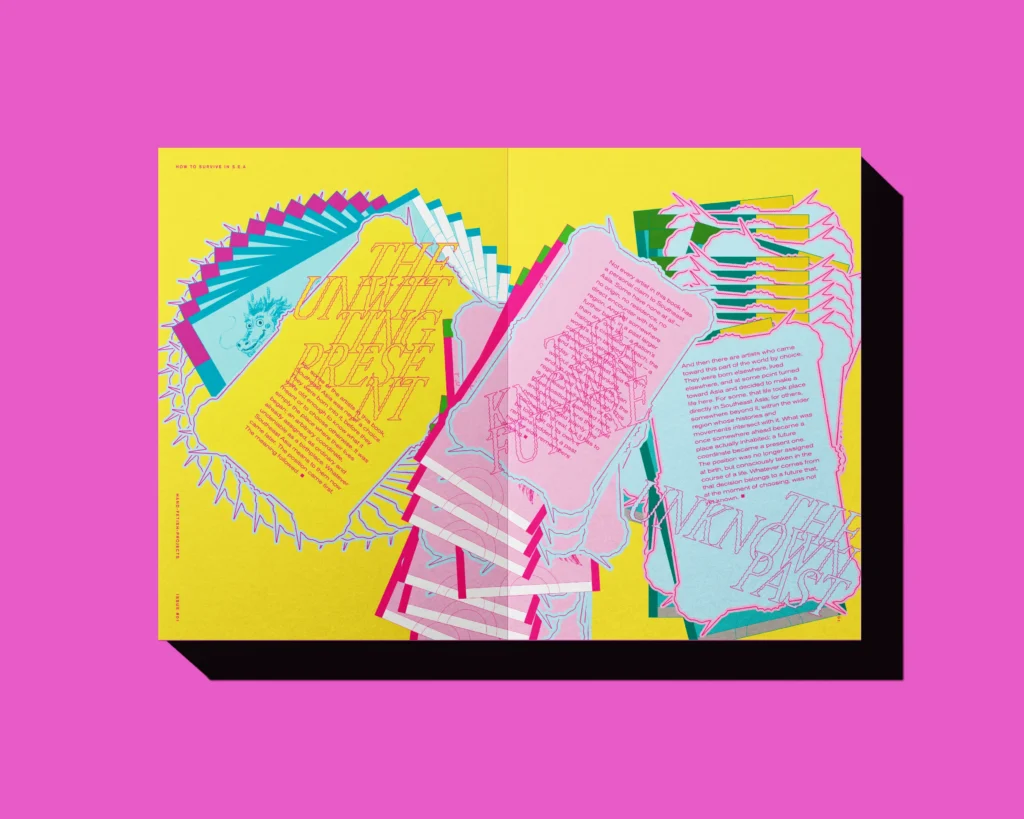
Nobody submits this page. Someone has to design it. Designed by Hand-Fetish-Projects.
Artists, of all people, should understand that attention is work. Someone has to open your files, look beyond the thumbnails, read your statements, and spend time figuring out what you are trying to do. Someone has to decide whether your work belongs, what it might mean alongside other works, and how it should be presented. A folder of submissions does not become an artbook by developing curatorial judgment on its own.
Who will work with printing partners, deal with technical problems, and handle the production details, those tedious tasks that rarely appear in an artist’s biography but are essential to completing a project? Who will cross trade barriers, jump through bureaucratic hoops, and breach the Great Firewall to connect artists on opposite shores of the Pacific? Who will negotiate with people who have no particular reason to care about your work, build relationships, and somehow get your art onto a stage far beyond your own reach, not to mention the resources required to build that stage?
And the curator is only one part of the machinery. Someone has to design the publication; someone has to build and maintain the digital infrastructure that keeps it accessible; someone has to make sure the files, layouts, formats, and technical details actually work. None of these tasks completes itself out of professional courtesy. A designer cannot pay rent with the satisfaction of contributing to another designer’s visibility, and a developer cannot maintain a website with exposure. Everyone involved has time to account for, work to deliver, and bills to pay. Somehow, the only labour that seems to require no explanation is the labour artists expect others to provide.
A set of nails lasts two weeks. That, too, is a fleeting pleasure, yet nobody seems troubled by paying $100 for it. Meanwhile, whether your work gets selected or not, a curator, a designer, and a developer have already spent some of their 525,960 hours on this earth considering your submission. That is the total number of hours in a sixty-year lifespan. The nails will come off in fourteen days. Those hours are gone for good. Which one of us is supposed to be exploiting whom?
We are supposed to be operating on equal terms in this capitalist world, are we not?
Hoang-Dan Pham
An artist and cultural operator based in Southeast Asia.
Her work spans visual art, publishing, and independent institutional practice, with a particular interest in contemporary image culture and the systems that shape artistic visibility.
She founded Hand-Fetish-Projects in 2024.
Should We Join in The Game We're Set To Be A Loser? Obviously Yes
There is a particular kind of humiliation reserved for artists from peripheral regions. It is not the humiliation of being ignored. That part is almost routine. The more efficient humiliation is subtler: it is being taught to interpret every rejection, every failed submission, every awkward silence from a foreign platform as proof that your work simply “isn’t good enough.”
No one needs to insult you directly. The system does it for free. It hands you a polished vocabulary of merit, professionalism, curatorial rigor, international standards, and artistic relevance, then quietly invites you to conclude that if you cannot pass through its gates, the fault must be yours. Maybe your work is too provincial. Maybe your statement is too plain. Maybe your references are too local. Maybe you, unfortunately, were born in the wrong place and failed to correct it with enough theory.
That is the game. And like most elegant games, it works best when the losers blame themselves.
I. The aesthetic insecurity of compressed modernity
One of the stranger conditions of being in Southeast Asia is that we did not enter contemporary visual culture through the same route as the places that now dominate it. We did not move neatly from postwar consumer culture to early internet subcultures to niche digital communities to platform capitalism. Our transition was far messier, faster, and far less generous.
A large part of the region jumped from material scarcity into accelerated digitization with very little time in between. By the time a meaningful middle class could participate in global consumer culture at scale, many of the visual languages circulating online had already gone through several generations of mutation elsewhere. What arrived to us was often not the slow formation of those cultures, but their finished products: the merchandise, the aesthetic signals, the approved taste objects, the neatly packaged symbols of belonging.
This is where Labubu becomes useful—not because Labubu itself matters that much, and certainly not because the world needs one more essay pretending a toy is a civilizational turning point. It is useful because it reveals a pattern.
Labubu enters many Southeast Asian contexts not as part of a long, locally embedded history of toy culture, internet subcultures, underground illustration, character design, retail display culture, and fandom economies. It arrives as a completed object of desire: already amplified by celebrity, already legitimized by circulation, already wrapped in the comforting glow of “the world has decided this is cool.” In other words, by the time it lands here, the object is no longer just an object. It has become a certificate.
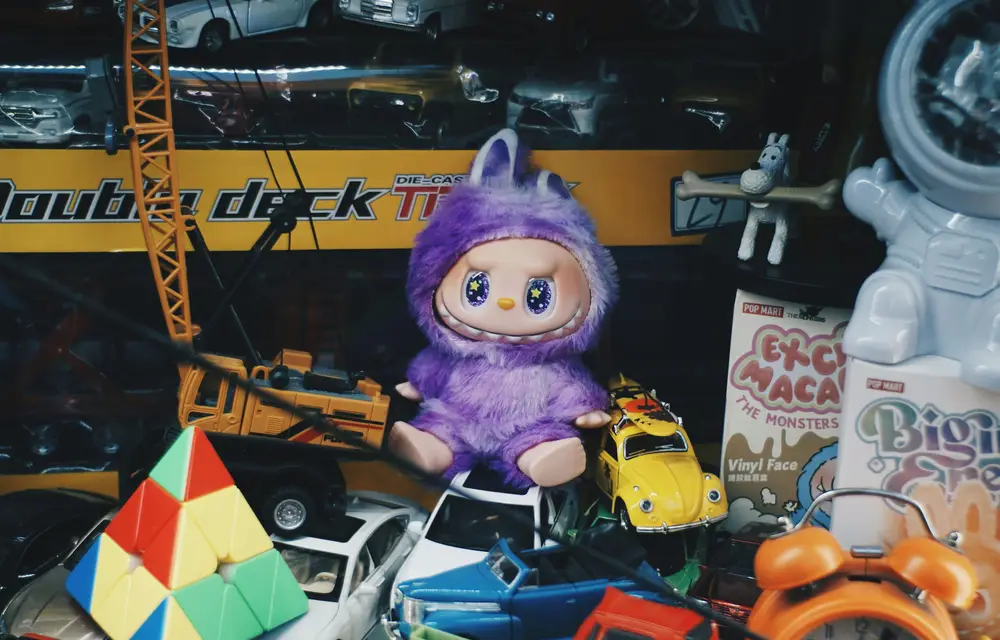
A scattered arrangement of art toys, mixing early internet-era toys with later-generation designer collectibles, with a purple Labubu placed at the center.
The problem is not that people buy it. The problem is not even that people buy it because Lisa touched it, and therefore it must contain some trace of divine aesthetic truth. Pop culture has always been ridiculous. That is part of its charm. The problem is what happens when a society repeatedly encounters aesthetic forms in this finished, pre-approved state. You stop asking where they came from, what traditions produced them, what histories shaped them, what kind of visual world they belonged to before they became commodities. Instead, you learn to read value through circulation itself.
Who is holding it? Which celebrity posted it? Which platform is selling it? Which country exported it? How expensive is it? How difficult is it to obtain? How efficiently does it signal that one is not embarrassingly local?
This is not taste. This is outsourced confidence.
And once that habit settles in, it does not remain confined to blind boxes and collectible toys. It becomes a wider cultural reflex. Aesthetic value begins to look inseparable from external validation. What has already been approved elsewhere starts to feel inherently superior to what emerges from within the region itself. The imported object does not just circulate; it also teaches the public how to judge.
This is where aesthetic insecurity begins to harden into something more structural. A region that receives many cultural forms as completed products, rather than as lived histories, becomes especially vulnerable to confusing visibility with value. It mistakes distribution for depth. It mistakes foreign circulation for legitimacy. And sooner or later, that same reflex returns home and starts evaluating local artists with borrowed eyes.
II. The game is rigged long before the artist uploads the portfolio
The same mechanism reappears, in a more polished form, when artists from peripheral regions step into the international art world.
An artist in Vietnam can spend years building technique, intuition, and visual intelligence through actual practice—through materials, through mistakes, through the long humiliating labor of making bad work until something alive begins to emerge. That part is real. But the moment the work is brought into a transnational art platform, the criteria shift. Suddenly the artwork is no longer being encountered only as an object. It must also arrive as a statement, a discourse, a position, a well-behaved paragraph of self-translation.
And of course, translation is never neutral.
In Southeast Asia, even the indie scene rarely has the conditions to split labour from artistic practice. It is hard to build an autonomous layer when the wider culture is still caught in a half-digested illusio of artistic legitimacy.
The contemporary art world likes to present itself as a space of openness, experimentation, and critical sophistication. What it often is, in practice, is a machine for rewarding legibility to the center. Not always. Not universally. But often enough to become a pattern.
This does not mean every rejected artist is secretly brilliant. It does not mean every curator, gallery, or platform is part of some grand conspiracy against Southeast Asia. Some artists are underdeveloped. Some portfolios are weak. Some statements are bad because they are, in fact, bad. That is not the issue.
The issue is that these systems are repeatedly framed as if they were neutral detectors of quality, when in reality they also test for a whole set of secondary competencies: fluency in a certain kind of theoretical language, familiarity with particular institutional references, the ability to narrate one’s own work in terms that already sound internationally legible, and proximity—geographic, educational, linguistic, or social—to the discourses that the platform already knows how to reward.
For artists working from Vietnam or elsewhere in the region, this matters. It matters because the playing field is not merely uneven in the practical sense of shipping costs, weak infrastructure, or lack of access to collectors. It is uneven at the level of interpretation itself.
The artist is not only asked to make work. The artist is asked to produce the correct explanation of the work, in the correct accent, inside the correct intellectual weather system.
And when that translation fails, the failure is very quickly internalized as a moral and artistic failure of the self.
Maybe I am not sophisticated enough. Maybe my work is not contemporary enough. Maybe I do not know enough theory. Maybe I should learn to write like someone who has spent the last decade politely suffering in a London seminar room.
This is where the game becomes especially efficient. It does not simply exclude. It persuades the excluded that the exclusion is objective. It turns structural asymmetry into personal inadequacy.
That is why so many artists from peripheral contexts end up feeling ashamed in front of platforms that were never designed for them in the first place. They enter spaces whose norms, references, and prestige economies were built elsewhere, then read their inability to move smoothly within those spaces as proof that their practice lacks value.
But the inability to perform comfort inside a foreign institution is not the same thing as artistic failure. Sometimes it is just what structural distance looks like.
III. The privilege of partial illiteracy: HFP curatorial philosophy
Pierre Bourdieu had a useful word for the spell cast by institutions and their rituals: illusio. The term refers to the belief that the game matters, that its stakes are natural, that its rewards are meaningful on the terms it has set for itself. A field only has real power over you when you believe in its categories deeply enough to mistake them for reality.
The cruelty of the global art game is not simply that it excludes artists from peripheral regions. Exclusion is old news. The more effective cruelty is that it trains them to use the system’s own measuring tools against themselves. It convinces them that if they cannot satisfy the language, rituals, and validation structures of the center, then the problem must be a deficiency in the work, rather than a mismatch between a local practice and an imported apparatus of recognition.
Seen from that angle, growing up outside the center can produce a strange advantage. Not a moral advantage, not a romantic one, and certainly not the charming innocence some people like to project onto “the margins.” Nothing so flattering. The advantage is colder than that.
If you were never fully initiated into the sacred language of the game, you are slightly less likely to worship it.
It is like overhearing a language you do not speak fluently. Native speakers are caught inside the meaning of every phrase; they hear prestige, hierarchy, nuance, coded affiliation, career possibility. You, meanwhile, hear the mechanics. You hear the rhythm, the repetition, the formula, the way certain sounds unlock certain doors. You notice how often authority depends not on insight but on fluency in a very specific performance of intelligence.
This does not mean theory is useless, or that academic language should be burned in a dramatic bonfire somewhere behind a biennale. It simply means that distance can clarify function. When you are not fully seduced by the ritual, you are sometimes able to see it as infrastructure rather than destiny.
That distinction matters in curatorial practice.
From Hand-Fetish-Projects’s point of view, the task is not to pretend the international art system does not exist. It exists. It indexes, circulates, archives, ranks, legitimizes, and occasionally opens doors. It can be useful. It can generate visibility, context, backlinks, institutional references, and all the other little digital sacraments that keep cultural objects moving across the internet. Refusing to touch any of it in the name of purity is not resistance. It is often just another route to invisibility.
But usefulness and authority are not the same thing.
In practice, what Hand-Fetish-Projects (HFP) has learned from watching these dynamics is fairly simple: art platforms, curatorial jargon, academic discourse, and international visibility should be treated as tools, not as final judges of value. They can be used as infrastructure. They should not be mistaken for truth.
This is not a rejection of context, or language, or critical framing. It is a refusal to let those things become substitutes for the work itself.
Once the fog of prestige is pushed aside, a more basic question returns: does the work hold? Does it have internal structure, visual intelligence, pressure, conviction, formal coherence, emotional charge, material discipline—whatever combination of forces makes an object feel genuinely alive rather than merely well-described? Has the artist actually built something, or merely learned to escort a mediocre object into the room with excellent vocabulary?
That question is not anti-intellectual. If anything, it is the minimum requirement for intellectual honesty.
In HFP’s curatorial practice, this means trying to keep a deliberate distance from the reflex that equates external recognition with artistic worth. It means being willing to use the infrastructure of the global art world when necessary—to submit, to format, to optimize, to circulate, to make oneself legible enough for the machine to process—without confusing that legibility with the actual value of the work.
Because no, we do not get to opt out of the internet. No, we do not get to float above global circulation like some morally superior ghost. And no, the answer is not to retreat into a wounded localism and pretend every foreign system is fake.
The answer, unfortunately, is less glamorous.
Yes, join the game.
Submit the work. Use the platform. Take the backlink. Exploit the metadata. Let the machine index your existence if it must.
But do it without kneeling.
The point is not to reject the game. The point is to stop confusing it with judgment. Once that confusion is gone, something useful becomes possible: you can participate in the infrastructure without surrendering your criteria to it. You can learn the rules without mistaking them for natural law. You can enter the room without asking permission to exist there.
And for artists working from places that were never meant to be the center, that may be the closest thing to freedom currently available.
Hoang-Dan Pham
An artist and cultural operator based in Southeast Asia.
Her work spans visual art, publishing, and independent institutional practice, with a particular interest in contemporary image culture and the systems that shape artistic visibility.
She founded Hand-Fetish-Projects in 2024.
For anyone seriously engaged with contemporary art, Nieves is almost impossible not to know. Within its niche, it functions as a benchmark—an entity recognized less through formal authority than through sustained cultural presence and quiet consensus.
There is a genuine sense of admiration in how I relate to it. I have followed Nieves for a long time and continue to return to it regularly, not only to see new selections but also to spend time with the artists they feature. The experience is not primarily analytical—it is affective: a slow drift through a curated visual field, closer to a private museum visit than to research.
From a professional standpoint, I also respect its curatorial consistency. The selection reflects a clear and stable sensibility. In that sense, Nieves is not approached with doubt, but already accepted as meaningful within its own domain.
However, I am not only an artist. I also occupy, in an early and unstable way, a curatorial position, and I have spent time inside commercial and semi-commercial creative environments where visibility is not symbolic but operational—something that must be actively managed.
From that position, I work with a condition I name Algorithmic Postmodernism: a condition where legitimacy is no longer grounded in verification, but in the repeated circulation of visible signals that shape perception, often producing recognition before direct experience and establishing belief before evaluation.
Under such conditions, I have found myself paying close attention to the Instagram accounts of art institutions, publishers, curatorial platforms, and artist-run projects around the world—not only as an artist, but also as someone attempting to build an ecosystem of my own within the same environment. Instagram is particularly interesting because it reveals how institutional authority is maintained under algorithmic conditions, where curatorial legitimacy must continuously encounter and negotiate with systems of visibility that operate beyond curatorial judgment itself.
This is not a skeptical question in the postmodern sense. It is not about exposing grand narratives. It is about understanding how legitimacy is maintained through repeated signals of visibility.
Nieves is particularly interesting in this regard precisely because its legitimacy is already widely accepted. The question is not whether its curatorial authority is real, but how that authority continues to circulate and reproduce itself within environments increasingly governed by algorithmic visibility.
With this in mind, I began to observe Nieves' Instagram more closely.
Observation: Nieves on Instagram
On Nieves' Instagram, a consistent structural pattern emerges.
Some posts receive several hundred likes. Under these posts, comments are often minimal—frequently reduced to emojis or short affective responses. What is consistent, however, is that these comments are almost always individually liked, suggesting not passive reception but a continuous reinforcement of interaction at the micro level.
At the same time, other posts—often positioned directly adjacent within the same feed—receive only a small number of likes. The difference is not gradual or proportional. It is abrupt. There is no clearly visible shift in curatorial direction, artistic quality, or selection logic that would fully account for this variation in engagement.
What becomes visible here is not simply uneven reception, but an inconsistency in visibility distribution within a curatorial system that otherwise appears coherent.
Interpretation: What This Structure Reveals
From the perspective of digital circulation, this pattern suggests that engagement is not purely an organic reflection of curatorial value. It is shaped by the interaction between platform logic, timing, and post-publication reinforcement mechanisms that determine how visibility is stabilized after a post is released.
This is where the structural question emerges.
If curatorial legitimacy is grounded in expertise, selection, and institutional coherence, then in principle it should be sufficient to secure recognition. However, in an algorithmically mediated environment, recognition is no longer guaranteed by curatorial authority alone. It must pass through a second system that does not evaluate expertise, but responds to engagement signals.
This introduces a structural third actor: the algorithmic system.
Even highly established curatorial entities such as Nieves therefore operate under a split condition. Their curatorial authority remains intact at the level of selection and intention, but their visibility is partially governed by a system that does not recognize that authority directly.
From this perspective, uneven engagement is not an anomaly or deviation. It is a structural effect of operating within two overlapping regimes of legitimacy: curatorial legitimacy and algorithmic visibility.
Importantly, I do not write this as a critique of Nieves, nor as an attempt to expose anything hidden behind it.
What I observed only reinforced a suspicion I already held: the distinction between "organic recognition" and "constructed visibility" has become increasingly difficult to separate. Both now exist within the same environment, shaped by the same systems of circulation and attention.
For that reason, I do not see Nieves as an exception to algorithmic culture. Like every contemporary curatorial platform, it operates within it. Its authority still comes from its curatorial vision, its selections, and the artists it chooses to support. But that authority must also pass through infrastructures of visibility that did not exist in the same way a generation ago.
Rather than seeing this as a problem, I increasingly see it as an ethical reality of contemporary cultural practice. If audiences are already navigating environments shaped by algorithms, then helping meaningful work survive within those environments is not necessarily a form of deception. It may simply be a form of adaptation.
Perhaps this is why my response is ultimately one of understanding rather than suspicion. The conditions I observe in Nieves are not foreign to me. They are, in different ways and at different scales, the same conditions I encounter in my own practice.
Hoang-Dan Pham
An artist and cultural operator based in Southeast Asia.
Her work spans visual art, publishing, and independent institutional practice, with a particular interest in contemporary image culture and the systems that shape artistic visibility.
She founded Hand-Fetish-Projects in 2024.