Context Curation: When the Curator Works as an Artist
What Is Context Curation?
Postmodernism expanded the territory of artistic practice beyond the production of original objects. Selection, appropriation, arrangement, and recontextualisation could become artistic acts in their own right. The artist did not always need to make the material; the act of working with it could be the work.
AI complicates this proposition further. Images can be generated, texts can be written, and contexts can be assembled. Even the appearance of an artistic practice can be simulated. The question is no longer simply what has been made, or whether it is original, but what constitutes the trace of a human practice within the result.
For Hand-Fetish-Projects® (HFP), this question leads to the curator. A curator can select works, construct relations, and produce an interpretation. Yet existing concepts of curatorial practice and artistic authorship do not adequately describe what happens when the curator’s artistic material is the context itself. Context curation is a concept developed and named by Hoang-Dan Pham for HFP.
Context curation is an art practice in which the context is the work. The curator constructs relations between existing works, biographies, statements, and other material, giving these relations form through visual language and text. The artistic act lies in constructing a way of seeing; the trace of the practice lies in the particular decisions through which that context comes into existence.
The source works remain unaltered and attributed to their artists. The curator does not determine their artistic value or replace the artists’ accounts with a preferred interpretation. The context is constructed from the specific material at hand and cannot simply be transferred to another collection.
A Method Produced by Failure
HFP initially opened a call for art about Southeast Asia as a way to expand its publishing practice. The plan was straightforward: invite submissions, select works, and bring them together in an artbook. The curatorial problem came later.
When the call closed, a substantial portion of the submissions had little or nothing to do with Southeast Asia. Some artists had claimed a regional connection their work could not support.
In a conventional selection process, these works would have been rejected. HFP had a different problem to solve: how could they remain in a book about Southeast Asia without altering the works or rewriting what their artists said about them?
Part of the answer lay in the submissions themselves. An artist who claimed a connection to Southeast Asia through work that had no apparent connection to the region had still established a relation to the call, whether intentionally or otherwise. The claim could be read as part of the circumstances in which the work arrived. HFP began to consider these circumstances as material rather than noise.
The problem was no longer simply how to assemble art about Southeast Asia. It was how to construct a context in which works with different subjects, intentions, and geographical connections could be read together.
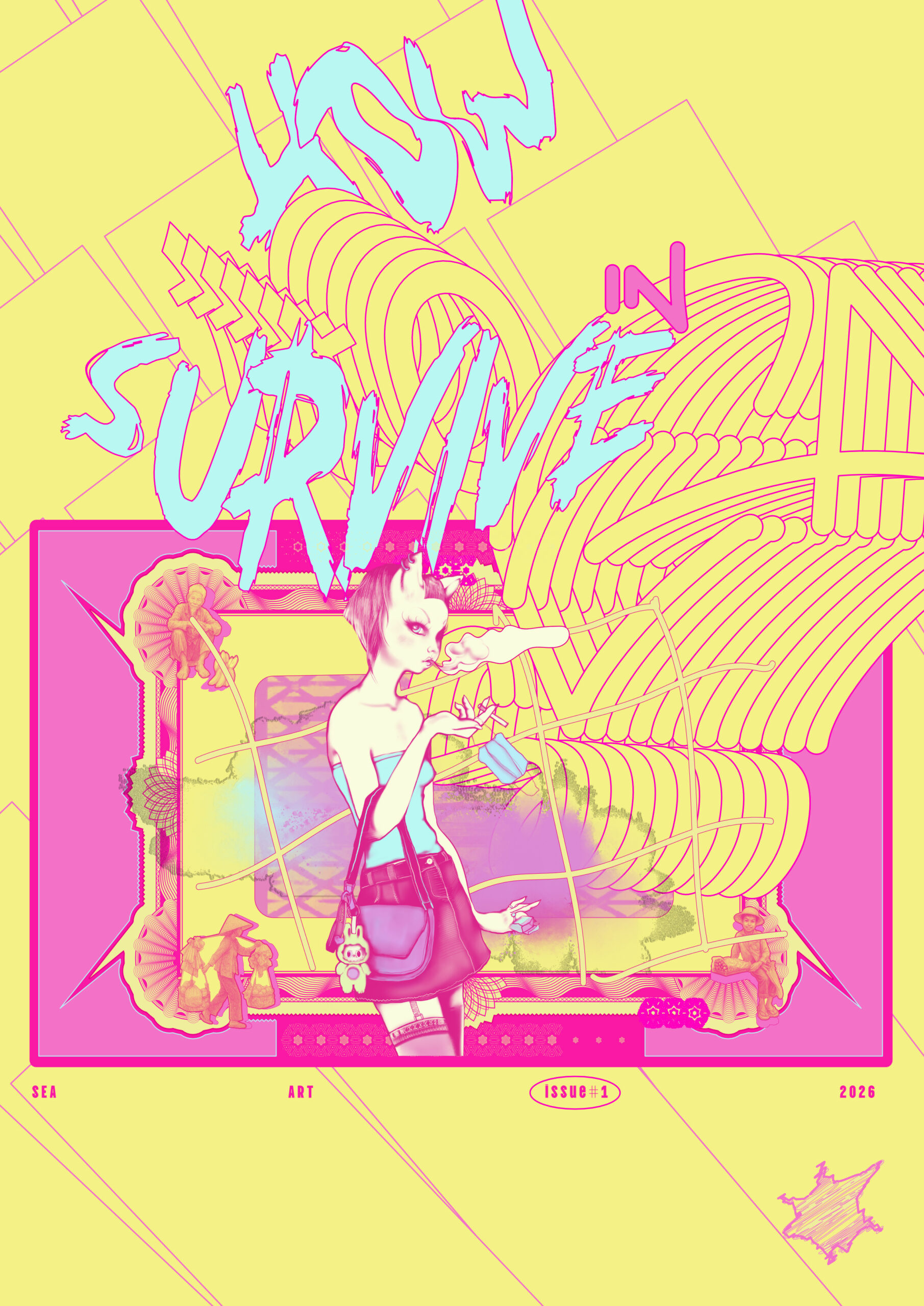
Rather than force the works to represent the region, HFP constructed a position from which they could be read in relation to it. The book took its visual language from the lottery ticket, an ordinary street object in Vietnam. Its 21 artists did not need to share a regional identity for the collection to acquire a curatorial position.
The failure of the original brief produced a different method of working. The material did not conform to the concept; the concept had to be built from the material.
This also changed how HFP understood the artist’s biography and statement. They were not merely documents accompanying the artwork. A biography presents a claimed history; a statement presents a claimed intention. The work, the account of the work, and the circumstances of its submission could each contribute to the context, whether or not they agreed with one another.
The curator’s task was not to resolve these discrepancies on the artist’s behalf. It was to construct a way of seeing through them.
HFP’s contribution was the context itself, given form through visual language and text. The source material remained as it was.
The first issue of SEAthrough became the first instance of this method, although the concept had not yet been named. Its full account is on the SEAthrough page.
Where It Stands
The curator as artist is not a new proposition. Duchamp expanded the possibilities of artistic authorship through selection and framing. Boris Groys has examined the increasingly porous boundary between artistic and curatorial practices. Context curation takes its place within this broader discussion, with a specific distinction: the curator’s material is the context constructed around works that remain unaltered.
Nicolas Bourriaud’s Postproduction (2002) is a closer point of comparison. Bourriaud examines artists who work with existing cultural material, using figures such as the DJ and the programmer to describe practices of selection, recombination, and recontextualisation.
The difference lies in where the artistic intervention occurs. In postproduction, existing material becomes the basis for a new work. In context curation, the curator works through relations between works without remaking them. The resulting context is the artistic construction.
Magdalena Malm’s Curating Context (2017) is a nearby reference in terminology. The distinction HFP draws is in the source of the context: it is constructed from the works, biographies, and claims themselves, each already carrying a context of its own.
HFP has not found an established practice that brings these three conditions together: the curator working as an artist, the source works remaining unaltered, and the artists’ own contexts serving as material. This describes the limits of HFP’s research, not the limits of what may exist.
Context curation is a concept developed and named by Hoang-Dan Pham for Hand-Fetish-Projects® (HFP) on 25 October 2026. The concept came after the practice. SEAthrough Issue 1 was published in October 2026; the name followed the work of identifying what the practice had become.
In Vietnamese, giám tuyển ngữ cảnh remains a provisional term. It is serviceable, though not quite right.
How context curation sits within Algorithmic Postmodernism is the next question.
