On Invented Biographies
What Has the Artist Made?
Suppose an artist invents a biography.
Not an embellished sentence or an exhibition date remembered generously. An invented history. A practice with a past that never happened, exhibitions that never took place, a career assembled from nothing but words. What, exactly, has the artist made?
The immediate answer is a false biography. In an institutional application, that may be enough to end the discussion. But context curation — as defined by Hoang-Dan Pham for Hand-Fetish-Projects® (HFP) — is concerned with another question: what happens when the act of inventing that history enters the work?
A Case From 2012
The weight a profile can carry has already been demonstrated in practice. In 2012, Canadian artist Joshua Schwebel submitted an exhibition proposal to articule, an artist-run centre in Montréal, under the name of established artist Micah Lexier, using Lexier’s name, CV and portfolio without his knowledge or permission. The committee accepted the proposal despite finding it incomplete, partly because Lexier’s established reputation made the risk of exhibiting it seem minimal. Schwebel had set out to test whether reputation could outweigh a deliberately weak proposal, and the selection process gave him his answer. He subsequently presented PLEASE DO NOT SUBMIT ORIGINAL WORKS, an artwork examining reputation, quality and the administrative structures through which art is selected. The name outweighed the proposal, and once the deception was revealed, the act of using it became the work. Source: Esse magazine.
A Biography Is Already a Construction
An artist’s biography is already a construction. It selects certain events, leaves others out, arranges a sequence and presents that sequence as a meaningful account of a person. The conventional biography is expected to remain faithful to the facts. Yet its form is no less constructed for that reason. Someone still decides which facts deserve to appear, what order they take and what kind of artist they are made to describe.
Fabrication crosses a line that selection does not. The distinction matters, but it does not make the act of fabrication disappear. Someone has imagined a history, given it a form and submitted it under their own name. That action can become material for art, whether or not the resulting biography can pass as evidence.
HFP does not need to declare the invented history true. It does not even need to find the story admirable. The point is that the artist has done something beyond producing an image: they have made a claim about who they are, and placed that claim beside the work. Context curation can take that decision seriously as material without accepting the claim as fact.
A fabricated biography can be part of an artwork without becoming a true biography. This is not a clever way of excusing fraud. It is a distinction between the status of a claim and what an artist does by making it. The two can occupy the same context without becoming the same thing.
When the Context Changes
Imagine that the biography is removed from the artbook and submitted to an institution, a prospective employer or a funding body. Its status changes immediately. The same words that entered one context as artistic material may become false evidence in another. Context does not absolve the artist, and art does not suspend every consequence. It simply means that a claim does not have one universal function wherever it appears.
A Hypothetical in SEAthrough Issue 01
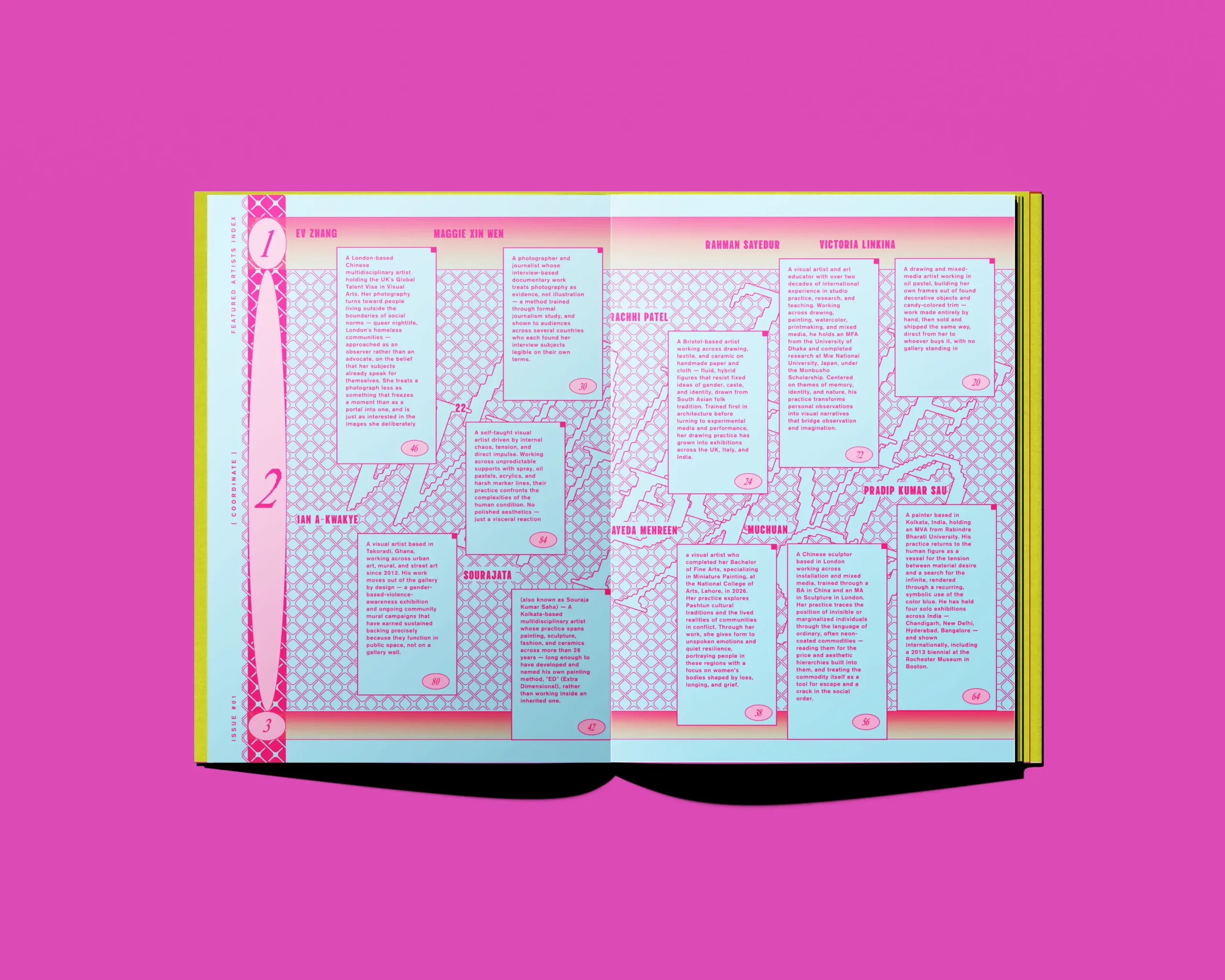
The biographies in SEAthrough Issue 01 were real and checked by HFP. The following is hypothetical. Suppose one had been invented. Its presence would not automatically destroy the curatorial work. It would introduce another action into it, another claim to be read alongside the work and the other material. Whether that action made the resulting context more interesting is for the work to establish.
There is no need to pretend that every lie is art. Most lies are probably just lies. But the possibility that a lie can become artistic material should not be dismissed merely because it begins as a lie.
The artist remains responsible for inventing the biography. HFP remains responsible for the context in which it appears. Neither responsibility requires the other to disappear.
